Finished reading: Farthing by Jo Walton 📚
I bought this Jo Walton book at Black & Read in Arvada, because I happened to see the name Jo Walton on the cover, and Jo Walton is on my radar. I found out about her through a podcast she did with Ada Palmer where the two of them talked about their interests in Science-Fiction/Fantasy and writing craft. I found out about Ada Palmer 5 or 6 years ago on a list of sci-fi books with interesting gender stuff (her Terra Ignota does gender neutral pronouns in a wild way). This is the second Jo Walton novel I’ve read, after Everybody’s Perfect (dreamscape, timeless Venice). This one is an alternate history in which Britain signed a peace treaty with Hitler.
I’m realizing… there’s a lot to say about the specifics of Farthing’s plot and characters and style, but I wont do that just yet, because first I want to articulate a general question I had while reading this book, but it’s also a question I’m having while reading other books this year, related to the fact that I might want to write a book someday, which is, How do books work? Obviously, there are many kinds of books and many things each author is doing with their books, so lots of different ways books work. But, I’m just trying to say that I read Farthing as part of a diffuse, vague, ill-defined (ie. just personal, intuitive) research project I’m doing about what books are, how they function in my life and what kinds of books I like.
That said, Farthing is an alternative history, murder mystery, thriller about fascism, class and identity in 20th century England. I felt like I was in safe hands with an author who clearly knows what she’s doing. I felt entertained, carried along. There were lots of great descriptions of food and clothing, very nice easing into the plot and then ratcheting the tension towards the middle and end of the book. Some poignant lines and revelations. And I CARED about the characters: some I was rooting for, others I felt annoyed with, others I found contemptible. And because it was all words (not a graphic novel, not a movie), it came together in that weird, wonderful way words take shape as images in the minds eye. The narrative had plenty of momentum.
Contrasted with the last book I read, Susan Moon’s Tofu Roshi, which was a satire about student teacher relationships in a spiritual lineage… Farthing had me feeling tensions and releases about how an entire national society and power structure would turn out. Even though Tofu Roshi had a narrative and some dramatic stakes, it was still in the realm of self-help books, so it was implicitly about me thinking about me or thinking how could a teacher help me. Farthing didn’t make me think of myself in any obvious way.
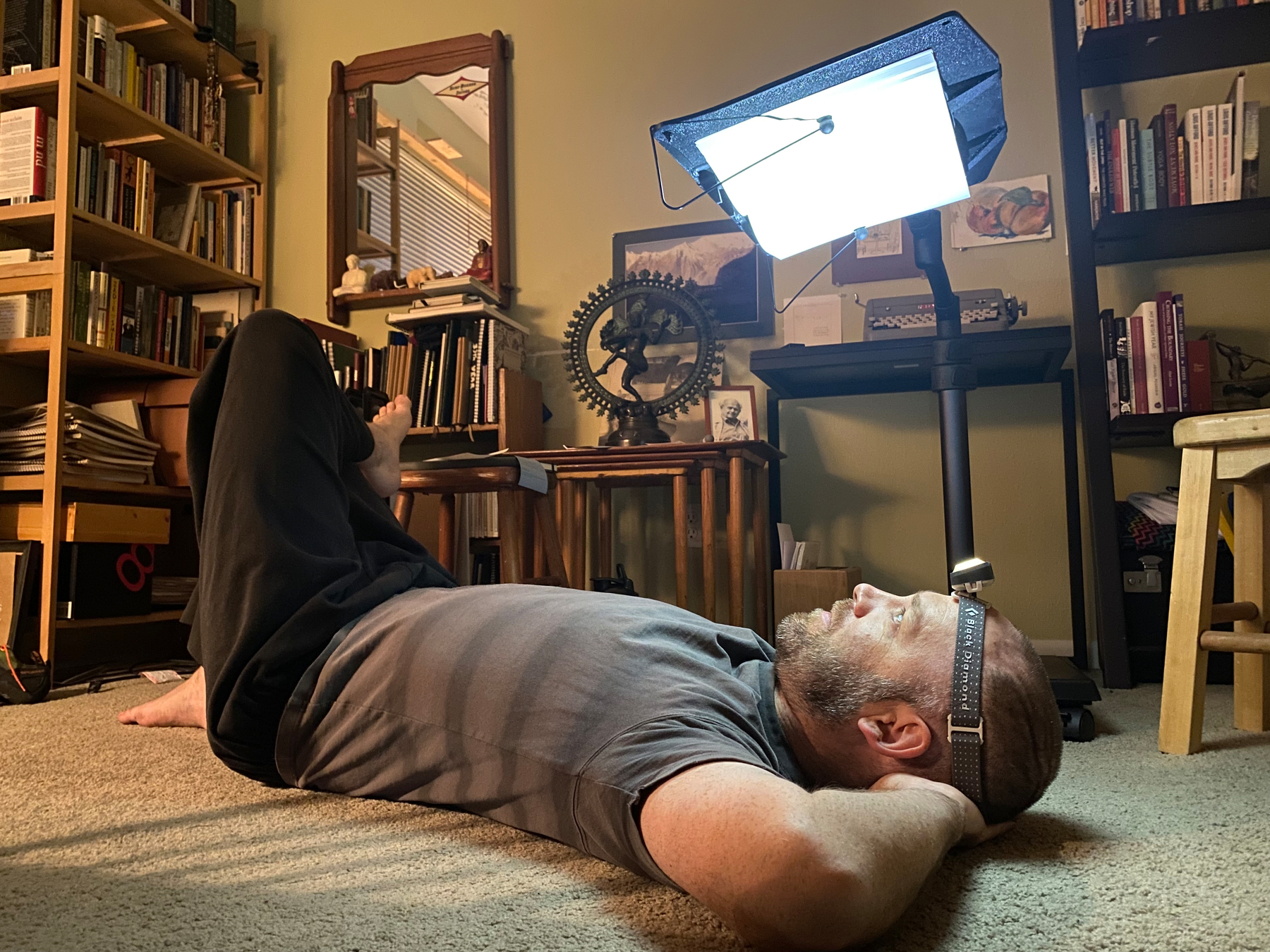
I liked this book. But, actually the most novel thing about reading this novel was how I read it: with the book strapped onto a reading stand (Levo G2 Adjustable Book Floor Stand), pages facing the floor, suspended three feet directly in front of my face as I lied comfortably on my back. Reading hands-free like this is a revelation. Over the course of the three days during which I read Farthing, I didn’t feel any of the normal physical stress, strain or discomfort that usually comes along with doing books, ie. neck bent forward, eyes down, or arms holding the book up in increasingly strange positions as I get fatigued. So, a mixed up post: there was Farthing, the novel, but there is also my question of what kind of book is this and how is that related or not to the kind of book I might like to write, and then there’s also finding and buying the book holder, which is so great, and will be an integral part of me reading many more books to come, so comfortably.