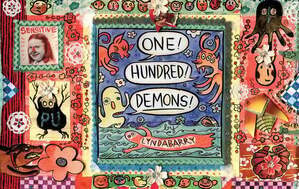
Finished reading: One! Hundred! Demons! by Lynda Barry 📚
Lynda Barry makes cartoons and One! Hundred! Demons! contains a good number of them. Some of Linda Barry’s recent books give self-help-ish advice about being creative, and I think this book marks the moment when that impulse came into her work. 2002.
When I started checking out Lynda Barry, less than a month ago, I first found Making Comics (2019), which definitely instructs. Then Picture This (2010) and What It Is (2008), and Syllabus: Notes from an Accidental Professor (2014), all instructional, all check-out-able from my local library network.
I know about Barry because Austin Kleon (also self-help) frequently calls her his hero, so I came to LB on a self-help vector.
One! Hundred! Demons! shows the moment when LB got inspired by a library book about Zen brush and ink techniques that changed her way of working and led to Demons presenting themselves to her (or through her (brush)). LB’s roots studying with Marylin Frasca at Evergreen State in the 1970s, who in turn studied with Ira Progoff (Intensive Journal Jungian Self-Helper), suggest self-help lineage. Her first book was published in 1981 and I think from the 70s up through 2000 she was mainly working as a comics maker.
Ernest Becker (1924-1974), in Denial of Death (1973) talks about artistic creativity being one of our cultures acceptable forms of death denial. Lynda Barry’s books riff on a theme about the moment in most kids' lives when they learn that they can’t “really” draw, can’t draw realistic hands for example. So self-help, in her books, has this flavor of returning to something perhaps child-ish. Returning to the scene of death, when some willingness to creatively self-express got snuffed out.